Water-Wise Plants
Summer in Alberta is often hot and dry which can pose challenges for gardeners. Dry heat often means extra watering and garden maintenance, but this doesn't stop us from wanting to beautify our yards. If anything, we want to be outside enjoying them more, savouring the long days of our short summer. Choosing "water-wise" plants can help reduce both water use and maintenance, so you can spend less time watering and more time enjoying your garden (the environment and your bank account will thank you too).

Plants need regular watering during establishment — no matter what! The more established a plant becomes, the more drought tolerant it will be. Annuals typically take about three weeks to establish, while perennials, trees, and shrubs may take one or two years, though their water needs generally decrease after the initial three weeks. In this blog post, I’ll share some of the best plant choices for drought tolerance. I’ve also written a separate post on water-wise gardening practices if you’d like to dive deeper.
What Makes a Plant Drought Tolerant?
Many drought-tolerant plants share a few key traits:
CAM photosynthesis (Crassulacean Acid Metabolism) — This is a specialized type of photosynthesis that I won’t go into extensively here, but it’s well worth looking up because it really highlights how remarkable plants are. In simple terms, CAM plants keep their stomata closed during the heat of the day, which greatly reduces water loss, then they open them at night to “breathe” in carbon dioxide. The carbon dioxide is converted into malic acid and stored overnight. During the day, the plant breaks the malic acid back down into carbon dioxide to carry out photosynthesis while keeping their stomata closed. Plants that use CAM photosynthesis can use up to 80% less water.
Waxy, succulent, or fuzzy foliage — Waxy leaves help reduce water loss through evaporation, while succulent leaves store water to help the plant get through dry spells. Plants with small hairs on their leaves (or undersides) can also reflect heat and sunlight, helping reduce the amount of water loss.
Deep or shallow root systems — Deep roots allow plants to access moisture further below the soil surface, while shallow roots help them soak up surface water quickly before it evaporates.
Now let’s discuss the plants! Below are our top water-wise annuals, perennials, trees, and shrubs, along with a list of other great drought-tolerant options that didn’t quite make the top five.
Annuals
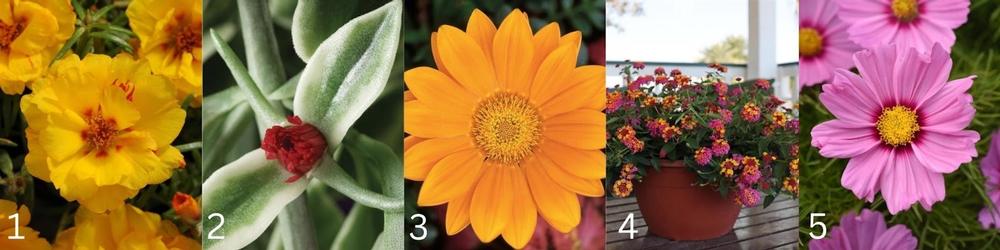
Native to the hot, dry plains of South America, Portulaca—also known as moss rose—blooms all summer long with vibrant flowers in a wide range of colours. It also attracts pollinators, butterflies, and hummingbirds. Portulaca checks all the drought-tolerance boxes: it performs CAM photosynthesis, is a true succulent with fleshy, waxy, needle-shaped leaves (in most varieties), and has a shallow root system.
While many trailing plants have high water needs, Dorotheanthus is a welcome exception. The variegated succulent-like foliage add interest all season long, while their small blooms create tiny magenta accents. Although it isn’t a true succulent, its leaves act as water reservoirs. Tiny, glistening bumps on the leaves are specialized epidermal cells that reflect sunlight and help reduce evaporation. Like Portulaca, Mezoo performs CAM photosynthesis and has a shallow root system. Mezoo is definitely our number one water-wise choice for trailers and is a great addition to any hanging basket or container.
Gazanias produce beautiful, daisy-like flowers that bloom all summer and attract butterflies and other pollinators. Their thick, leathery leaves, often with a slightly fuzzy or silvery underside, along with their deep root system, contribute to their drought tolerance. However, the trait that really sets them apart is their flower power: the blooms fully open in the sun but close at night and on cloudy days, helping conserve moisture and protect the plant from temperature fluctuations.
Lantana is one of my favourites because of its fragrant flower clusters that bloom all season long. It shares several traits common to water-wise plants, including a deep root system and a slightly waxy coating on its leaves, but it doesn’t stop there. Lantana is a highly adaptable plant that can adjust both its growth and internal processes in response to dry conditions. It can close its stomata to reduce moisture loss, limit leaf growth to decrease the surface area exposed to the sun, and lower its osmotic pressure and turgor to maintain structure when water levels are low. It may stop blooming for a period to conserve energy, but will resume almost immediately after a deep soak. Because of this adaptability, Lantana is able to recover quickly from periods of wilting and drought without permanent damage.
Cosmos thrive in low-nutrient, sandy, rocky soils with high heat and minimal water, as they originate from the arid regions of Mexico. Too much water can actually cause the plants to become floppy and overly leafy, rather than focusing their energy on blooms. Heat and low water are actually the perfect recipe to encourage flowering and can even shorten the time to bloom. Their deep root system and fine, thread-like leaves also help reduce water loss through transpiration.
Drought-Tolerant Container Recipe
Containers tend to dry out quickly, but the right plant choices can make a big difference. Here’s a water-wise container recipe that looks great while using less water:
Thriller: Dracaena
Filler: Geraniums (Caliente, Ivy, or Mini-Cascade)
Spillers: Mezoo, Artemisia ‘Sea Salt’, Lantana ‘Passionfruit’
Click here to learn how to design your own container.
Other water-wise annuals include: Livingstone Daisy, Angelonia, Zinnias, Vinca, Fibrous Begonias, Asparagus Fern, and English Ivy.
Perennials
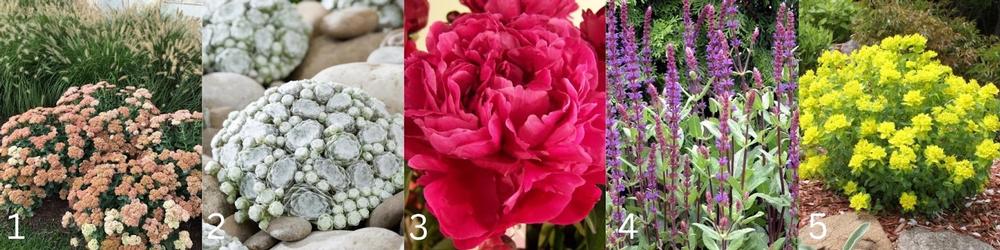
Sedums are at the top of the list when it comes to drought-tolerant perennials. Available in both upright and creeping forms, they come in a wide range of colours and heights. Sedums are true succulents, with thick, waxy leaves, and many species use CAM photosynthesis. Creeping varieties form dense mats that reduce exposure to drying winds and intense sun. They also have shallow root systems that quickly absorb available moisture. Fun fact: in dry conditions, sedums can adjust their growth ratio by producing more roots and less foliage improving their ability to gather water.
Also known as Hen and Chicks, Sempervivum are true alpine succulents, built to survive intense sun, wind, thin soils, and long dry periods. They truly hit all the signature characteristics of drought-tolerant plants being succulents that use CAM photosynthesis, have shallow root systems, and feature waxy leaves with fine hairs or powdery surfaces. One unique characteristic is their compact rosette shape, which doesn’t just look beautiful, but actually funnels morning dew or light rain toward the center of the plant and down to the roots.
You may not find peonies on other online lists of drought-tolerant plants, but here’s why they deserve a spot. Being early spring bloomers, they typically receive enough moisture from seasonal runoff to support their gorgeous blooms. By the time summer heat arrives, they’re usually finished blooming, and dry conditions have very little impact on them.
Perennial salvias have a few of the classic drought-tolerant traits, such as hairy leaves and deep roots, but they also have a few unique features. This surprised me, but one of these traits is their aromatic resins. The aromatic oils in their leaves are said to act like a natural sunscreen, protecting the plants from heat stress and intense light. Narrow leaves also reduce surface area, minimizing water loss, while woody crowns anchor the plant and help access deeper soil moisture.
Euphorbia, or cushion spurge, has a deep taproot and waxy, succulent-like foliage. Its dome, or “cushion,” shape helps shade the roots from the sun, keeping them cooler and more moist. The plant also produces a milky latex sap that helps regulate internal moisture and quickly seals wounds if the plant is cut or injured. Euphorbia doesn’t just tolerate drought—it prefers sandy, rocky, low-nutrient soils that are well drained, making it an excellent choice for the water-wise garden.
Other water wise Perennials include: Achillea, Daylilies, Dianthus, Liatris spicata, Solidago, Veronica, Lewisia
Trees & Shrubs
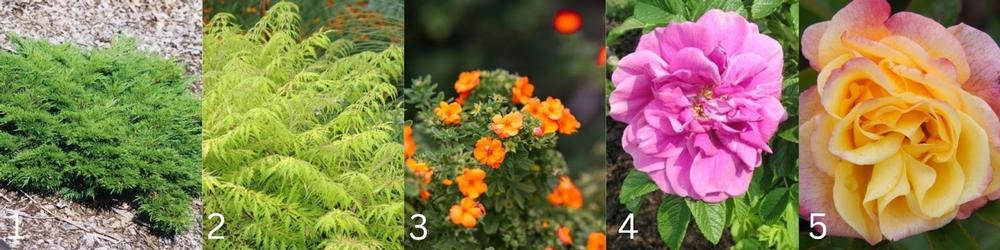
Junipers are the ultimate water-wise shrub, and the secret to their drought tolerance lies in their root system. Junipers develop a deep taproot that can extend up to 25 feet into the soil, along with an extensive lateral root system that can spread 100 feet or more from the base of the plant. The taproot allows them to access moisture deep underground, while the lateral roots absorb surface moisture over a wide area. Their scale-like leaves have a waxy coating that reflects heat and traps moisture inside the plant. During extreme drought, junipers can even enter dormancy or shut off water flow to specific branches, allowing them to prioritize the survival of the main trunk. These remarkable adaptations make junipers one of the most resilient and dependable shrubs for dry landscapes.
Staghorn sumacs are one of my favourite choices for adding fall colour to the landscape. Their narrow leaves turn brilliant shades of yellow, orange, and scarlet as the seasons change. When it comes to drought tolerance, the secret lies below the surface. Although they have a relatively shallow root system, staghorn sumacs spread rapidly through underground rhizomes, creating an extensive moisture-collecting network. Sumacs share resources, moving water and nutrients throughout the entire colony. Staghorn sumacs thrive in low-nutrient environments such as rocky slopes, where they’re often used for erosion control. During periods of drought, they may drop some leaves and slow top growth, but the root system remains healthy and ready to rebound.
Potentilla has a deep, wide-spreading root system and small, narrow leaves that reduce the rate of transpiration. Native to northern North America, it thrives in rocky, sandy, nutrient-poor soils and adapts well to both acidic and alkaline conditions. While potentilla is quite hardy once established, it should be watered once or twice a week during its first and second growing seasons. During drought, it may wilt and drop leaves, but it is extremely resilient and will quickly bounce back once water is reintroduced.
Like many drought-tolerant shrubs, Rosa Hansa has an extensive root system and handles poor soil conditions with ease. Because it’s native to coastal shorelines, it’s naturally salt-tolerant, which helps the plant manage its internal water balance in harsh, drying environments. Another unique feature is the wrinkled texture of its leaves—this reduces water loss through transpiration compared to roses with smooth, glossy foliage. Once planted, the rose establishes quickly and spreads through suckering, creating a dense thicket that helps shade the roots and retain ground moisture.
Rugelda Pavement Rose shares many similarities with Rosa Hansa, including coastal origins and crinkled, waxy leaves that reduce moisture loss. During periods of drought, the plant can enter dormancy, dropping some leaves while maintaining the health of its core structure. Although it is quite drought tolerant once established, Rugelda Pavement Rose takes a little longer to settle in and benefits from consistent watering during its first two to three years to help develop a deep, resilient root system.
Other water-wise Trees & Shrubs include: Amur Maple, Regent Saskatoon, Little Moses® Burning Bush, Turkestan Burning Bush, Blizzard Mock Orange, Dart's Gold Ninebark, Little Devil™ Ninebark, Cupid Cherry, Canadian Shield™ Rose, Morden Blush Rose, Above and Beyond® Rose, Cherry On Top False Spirea, Anthony Waterer Spirea, Goldflame Spirea, Fairy Queen Spirea, Dwarf Korean Lilac, Miss Kim Lilac, Royalty Preston Lilac, Dwarf European Cranberry, Common Snowball, Bailey Compact American Cranberry, Little Gem Spruce, White Spruce, Siberian Larch, Snowdance™ Japanese Tree Lilac
A hot, dry summer doesn’t mean your garden has to struggle. With the right water-wise plants (and water-wise practices), you can spend less time dragging hoses around and more time enjoying your yard. Think of it as gardening smarter—not harder. Choose plants that love our climate, give them a good start, and then sit back and let them show off.